Key Points:
- The Concept of Outer Space in Contemporary Islam
- The Islamic World and the Space Race
- An Overview of the Space Programmes of Major Muslim-Majority Countries
The Concept of the Cosmos in Islamic Ontology
It is undeniable that humanity is currently experiencing an unprecedented moment in history, in which numerous paradigms carrying profound anthropological implications are undergoing change at an unprecedented pace. This process is being driven by the exponential acceleration of technological development.
Against this backdrop, a new Space Race is taking shape, following the one that, theoretically—or rather, in practical terms, albeit temporarily—came to an end in the 1970s with the United States’ Apollo missions. The space sector can indeed be regarded as a primary driver and the ultimate systemic benchmark for the entire technological industry. This time, however, the competition is no longer a two-horse race, but rather a marathon involving numerous participants.
The two protagonists of the past, the United States and the (former Soviet) Russian Federation, undoubtedly remain dominant players. However, many others are seeking to compete and are doing so at the highest levels. China is at the forefront of this development, having now emerged as a direct rival to both, even surpassing them in certain respects. Other competitors include India, several European countries, and Japan. Despite starting from a considerably disadvantaged position, the Islamic world is also beginning to take its first steps in the same upward direction.
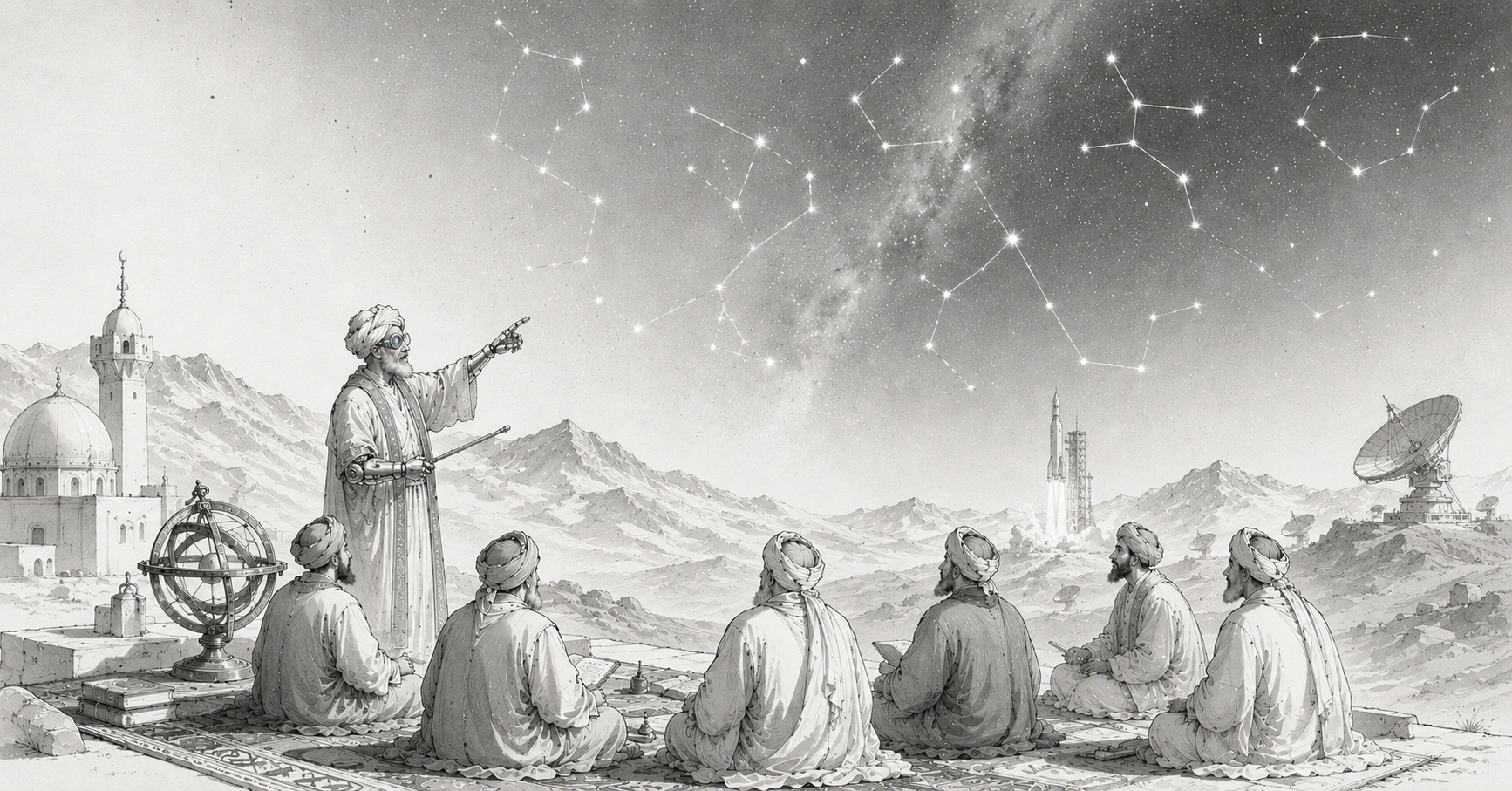
The delay in the Muslim world’s entry into the Space Race can be attributed to specific historical circumstances and, to some extent, to cultural factors. These, however, are themselves the product of particular historical dynamics rather than necessarily reflecting structural or immutable characteristics. On the contrary, Islam theoretically possesses a frame of reference particularly suited to the present era—one that Western modernity has entirely overlooked and that the Islamic world itself is only now beginning to discern, illuminated by modern science. In this respect, the West is indirectly acting as a catalyst for this process of discovery. Indeed, when approached through an interpretative framework that might broadly be described as modernist—that is, one that sets aside the constraints of Tradition whenever they prove ineffective, or even incapable of addressing the challenges of modernity—the Qur’an can be understood as a form of guidance grounded in a fundamentally non-anthropocentric conceptual framework and, consequently, a non-geocentric one.
In other words, it can be conceived as a system of ideas already predisposed to engaging with non-human intelligences and projecting human understanding towards outer space, which it even envisages as already inhabited. Put in these terms, such a proposition might appear absurd to anyone unfamiliar with the Qur’anic text. To some extent, it may also seem so to those who know the text but have no intention of introducing revisions to the interpretations that became established during the Islamic Golden Age, conventionally spanning approximately the eighth to the fifteenth–sixteenth centuries. Nevertheless, when approached through modern exegetical and hermeneutical methodologies, Islam’s sacred text makes it possible to transcend the historical contingencies of the seventh century and the centuries immediately following it, thereby opening onto a cosmic ontology in which the Universe is not an inert void existing for the benefit of humankind, but rather a system teeming with activity, celestial structures, and diverse forms of existence that are already operative.
Nor are “spatial” elements entirely absent from subsequent literature, although they remain obscured by the veneer of traditional iconography, which was itself long opposed by Islamic aniconism. This literature includes the aḥādīth and the biographical accounts of the Prophet par excellence, namely Muḥammad ibn ʿAbd Allāh, better known in Italy as Muhammad. The full potential of these elements, however, remains constrained by the filter of Tradition, which is firmly anchored in a pre-scientific past.
Islam in the Age of Cyber Technology, Artificial Intelligence, and the New Space Economy
The current challenge facing the Islamic world in its pursuit of space exploration, which epitomises the broader competition in the technological sphere, does not therefore lie in a faith that must be set against science, as conceived—and to some extent still conceived—by the Global North (which also includes Russia, a country that remains culturally more European than Asian). Rather, it lies in the ability to synchronise these two driving forces: to overcome the asynchrony of crystallised interpretative models inherited from the past and recognise that the Qur’anic universe, and subsequently that of early Islam, constitutes an architecture of portals in the heavens, traversable pathways across the firmament, and intelligences, such as the jinn and angels, operating on planes of reality that differ from, or even transcend, the biological one.
To achieve this, the Islamic world has little choice but to undertake a quantum leap, moving directly from the intellectual frameworks established during the Golden Age, which continue to shape it to this day, towards the horizons emerging with the age of artificial intelligence and space exploration. In other words, it must move forward without following the intermediate stages—the equivalent of “passing Go”—through which Western civilisation has gradually progressed, while avoiding any risk of losing its fundamental heritage: the Islamic faith and, more fundamentally, faith in the Holy Qur’an itself.
After all, the shock of witnessing the Islamic world being subjugated by powers possessing superior military and civilian technologies—first the Mongols and subsequently the Europeans—has already been experienced over the course of the past millennium. No Muslim is willing to find themselves once again in a position of complete subordination. Those within the Islamic world who possess strategic foresight understand that, in order to avoid being caught unprepared once again, its foundations must be reinforced and made capable of bearing new structural loads. Whether traditionalist Muslims approve or not, this undertaking requires the judicious acquisition of expertise and methodologies from the Global North, as well as from the Sinosphere, both of which represent equally distinct civilisational Others in relation to the historical trajectory of the Islamic world. This entails opening up to the wider world, a prospect that a clearly defined historical phase—the postcolonial period—had sought to avert through increasingly ineffective instruments such as neotraditionalism and radicalism.
This explains why, among Muslim-majority countries most actively seeking to achieve technological independence and, consequently, secure a place in the new Space Race, are those where intellectual debate is particularly vibrant concerning the potential inherent in contemporary readings of sacred texts and of Tradition more broadly. Over the past two decades, these countries have experienced an unprecedented expansion of their technological and industrial ambitions. This development will inevitably require a corresponding strengthening and advancement of their cultural foundations, a process that is therefore subject to constant institutional scrutiny—not so much for strictly doctrinal reasons as to prevent dissent and political unrest. Only in this way will it be possible to move rapidly beyond reliance on foreign contractors supplying turnkey technologies towards integration and collaboration, ultimately leading to the establishment of entire domestic industrial value chains.
Space Programmes of Major Muslim-Majority Countries: An Overview
With regard to the space sector, the landscape is structured around a number of clearly identifiable key players.
The United Arab Emirates (UAE), a country characterised by considerable cultural dynamism, currently represent the leading space power in the Arab world, thanks to a strategy strongly focused on innovation and global partnerships, including cooperation with the European company Thales Alenia Space, in which Italy’s Leonardo holds a 33% stake. The country has achieved international recognition through the success of the Hope probe (Al-Amal), which was successfully placed in Mars orbit, its full integration into the Artemis Accords, and the participation of Emirati astronauts in missions aboard the International Space Station (ISS). Alongside these exploratory initiatives, the UAE continues to develop Earth-observation satellites, such as KhalifaSat, as well as its programmes for the development of Rashid lunar rovers.
Türkiye, whose political and institutional approach has been characterised by pragmatism since the Kemalist revolution, has developed a highly strategic national space programme aimed at strengthening its industrial, scientific, and defence autonomy. The Türkish space programme is actively engaged in developing hybrid propulsion engines for future lunar missions. The country has also achieved a significant degree of autonomy through its Earth-observation and telecommunications satellites, including those belonging to the IMECE and Türksat series. Furthermore, Türkiye has already reached several important milestones, including the participation of its astronauts in missions to the ISS and in suborbital research flights.
Saudi Arabia, within the accelerationist framework of its strategic Vision 2030 plan, is rapidly converting its financial resources into technological sovereignty and the development of highly skilled human capital. This plan, which also encompasses a far-reaching transformation of the country’s cultural landscape, extending into the religious sphere, vividly illustrates the need to rapidly reconsider the relationship with Tradition while implementing the reforms required to avoid falling behind other global players. Among the main achievements to date are the resumption of human spaceflight through the Axiom-2 mission, which carried two Saudi astronauts into orbit, as well as substantial infrastructure investments and far-reaching cooperation agreements with leading international space agencies aimed at developing domestic space-component manufacturing capabilities.
Iran, the leading power in the Shiite sphere, follows an autonomous and self-reliant approach closely integrated with its industrial and defence sectors. This has enabled it to distinguish itself as one of the few countries in the region possessing an independent orbital launch capability, using its own launch vehicles, such as Simorgh and Qased. The Iranian space programme focuses primarily on placing satellites into orbit for both military and civilian purposes, including the Noor and Soraya series, alongside the periodic testing of suborbital capsules for biological research.
The multi-vector-oriented state of Pakistan, through its long-established space agency, SUPARCO, focuses much of its programme on developing satellite technologies for territorial monitoring, natural resource management, and telecommunications. In recent years, the country has significantly strengthened its scientific cooperation with China, going so far as to place payloads and CubeSats, such as iCube-Q, into lunar orbit aboard Chinese Chang’e exploratory missions. Islamabad has also secured a place in lunar exploration through its participation in activities associated with the International Lunar Research Station (ILRS), a future Chinese-led scientific base planned for the Moon’s south pole.
The pluralistic state of Indonesia bases its space policy primarily on geographical and infrastructural requirements arising from the management of its vast archipelago. Through its Palapa and SATRIA satellite networks, the country provides digital connectivity, emergency communications, and remote sensing services for natural disaster prevention. Indonesia is also pursuing plans to build a national spaceport, currently under development in partnership with Russia on the island of Biak.
Kazakhstan faces a particularly distinctive challenge in the development of its space programme, seeking to address a paradox that emerged following the dissolution of the Soviet Union. This Central Asian country is home to the Baikonur Cosmodrome, the oldest and largest space launch facility in the world. However, despite Baikonur being located on Kazakh territory, the Russian space agency Roscosmos leases the entire infrastructure under an agreement currently extended until 2050. In an effort to move beyond its role as a mere “landlord”, the space agency KazCosmos, established in 2007, has invested in the joint Baiterek project, which has led to the modernisation of launch facilities to accommodate the new Soyuz-5 rocket. Its operational debut in 2026 marks Kazakhstan’s transition from a passive observer to an active partner. Furthermore, the country already operates the KazSat satellite constellation, dedicated to telecommunications, and KazEOSat, focused on environmental monitoring, and has begun manufacturing its own satellites for international markets.
More broadly, after decades spent almost entirely in Russia’s shadow, Kazakhstan is now undertaking a decisive transition towards becoming an autonomous space power, diversifying its strategic partnerships through closer ties with China, the United States—including cooperation with NASA and SpaceX—and European countries. Among the latter, Italy is particularly noteworthy, with Thales Alenia Space involved in the development of KazSat-3.
Space Programmes of Other Gulf Countries: Oman and Qatar
Returning to the MENA region (Middle East and North Africa), Oman is developing the Etlaq Spaceport through the private company National Aerospace Services Company (NASCOM), which is set to become the first commercial spaceport in the entire region. Its location on the Arabian Sea coast offers favourable conditions for space launches, and several European companies have already signed agreements for launches expected to take place by 2027. As in other cases previously discussed, the project forms part of a broader economic diversification strategy, in this instance outlined in Oman Vision 2040.
Finally, the small but influential emirate of Qatar also deserves consideration. Its space sector, supported by the Es’hail geostationary satellites dedicated to telecommunications (with the next satellite to be developed in cooperation with Thales Alenia Space as the prime contractor), remains relatively modest compared with the more established programmes of other Gulf countries. However, from a cultural perspective—and this brings us back to the central question raised at the outset—Qatar is arguably among the Muslim-majority countries where intellectual debate concerning the relationship between Islam and extraterrestrial life is particularly active. Evidence of this can be found in the attention devoted to the subject by its international broadcaster Al Jazeera, the scholarly activities of academics based in the country, such as Jörg Matthias Determann of Virginia Commonwealth University in Doha, and academic events organised by institutions such as Qatar University, which include sessions explicitly dedicated to astrobiology and the search for extraterrestrial life.
The Holy Qur’an Among the Stars?
Overall, the Islamic world’s efforts to establish its own position in the space sector reflect both the need to diversify local economies beyond fossil fuel resources, as in the case of the Gulf countries, and the aspiration to acquire international prestige and technological sovereignty, as exemplified by emerging powers such as Turkey and Pakistan. These countries are navigating a path that combines close cooperation with major international players with an increasingly pronounced pursuit of autonomy in launch capabilities and technological manufacturing.
To provide a definitive boost to these endeavours, a broader opening of the popular imagination towards horizons already familiar to the Islamic tradition will be necessary. This process is, to some extent, already unfolding organically. For these horizons to be fully appreciated, however, they require a field of vision no longer obstructed by the burdens of the past.
BIBLIOGRAPHY
J. M. Determann, Islam, Science Fiction and Extraterrestrial Life: The Culture of Astrobiology in the Muslim World, Bloomsbury USA Academic, 2020.
J. M. Determann, S. A. Malik, Islamic Theology and Extraterrestrial Life: New Frontiers in Science and Religion, I.B. Tauris, 2024.
H. Mohi-ud-Din Qadri, Islam on Space Exploration & Migration: And the Reality of Gog and Magog, Minhaj Publications, 2022.
S. Rahman, Extraterrestrial Intelligence: Amazing New Insights from Qur’an, Furqania Academy Trust, 2012.
P. Tajbakhsh, Islam and Extraterrestrial Life, Cambridge University Press, 2026.
SITOGRAPHY
Mohammed Space Rashid Space Center – Emirates Lunar Mission
Eo PORTAL – Khalifasat
UAE Space Agency – United Emirates Space Agency Homepage
Wired.it -Emilio Cozzi 15.01.2024 Gli Emirati vogliono prendersi il loro posto nello Spazio
Turksat.com – Satellite
Turkish Space agency – Our Space History
Saudi Space Agency – Human Space Program
Institut Agama Islam Negeri Curup – Journal alistinbath
International Astronautical Federation – Iranian Space Agency
ISPI – When Iran Looks to Space, It Sees an Industry
SUPARCO – Major Programmes
International Astronautical Federation – Pakistan Space and Upper Atmosphere Research Commission
Associate Press of Pakistan – Pakistan, China agree to jointly develop space centre, train astronauts
VisionGt.eu – Kazakhstan Space Program
ICE Italian Trade &investment agency – KAZAKHSTAN-BAITERK-PROSPECTS
Gov.KZ – Baiterek Complex: A Successful Launch of a New Era in Kazakhstan’s Space Industry
ETLAQ.om – ETLAQ Official Website
Eshailsat.qa – Quatar Satelite company official website
AlJazera.com – Extraterrestrial
VCU.academia.edu – Jörg Matthias Determann
Qu.Edu.qa – Sabka in Qatar
Cambridge university press – Islam and Extraterrestrial Life
One response to “Space in the Islamic World: Challenges and Opportunities of the New Frontier”
[…] SWITCH TO ENGLISH VERSION […]